
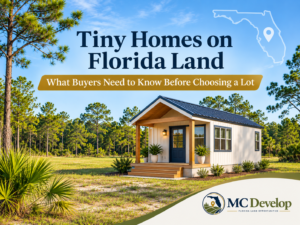
Can You Put a Tiny Home on Vacant Land in Florida?
Tiny homes have become an attractive option for buyers looking for a simpler lifestyle, a smaller footprint, or a more affordable way to own property in Florida.
But one of the most common questions land buyers ask is:
Can I buy a vacant lot in Florida and put a tiny home on it?
The answer is: sometimes — but the property itself must qualify for the intended use.
Buying a lot does not automatically give the owner the right to place any type or size of home on it. Zoning, minimum dwelling size, setbacks, utilities, septic requirements, flood conditions, and local permitting rules can all affect whether a tiny or small home can be built on a particular parcel.
Here are the most important things Florida land buyers should understand.
What Is Considered a Tiny Home in Florida?
The term “tiny home” is used broadly in real estate and everyday conversation.
Under the Florida Building Code framework, tiny-house provisions generally address dwellings of 400 square feet or less, excluding lofts.
However, that does not mean every Florida county or municipality will allow a 400-square-foot home on every residential lot.
Local zoning rules may establish:
- Minimum dwelling sizes
- Minimum lot sizes
- Minimum lot widths
- Setbacks
- Building height requirements
- Foundation requirements
- Permitted residential uses
In some areas, a jurisdiction may require a home to be larger than 400 square feet, even though buyers may still informally refer to the structure as a tiny or small home.
That is why zoning verification should come before choosing the house.
Start With the Property’s Zoning
Before buying land for a tiny home, find out the property’s zoning designation and what uses are permitted.
Ask the applicable county or city:
Can one single-family dwelling be built on this parcel?
Then ask specifically:
What is the minimum permitted dwelling size?
Do not rely only on the fact that neighboring properties contain small homes, manufactured homes, RVs, or other structures. Those properties may have different zoning, grandfathered uses, variances, or development histories.
Always verify the specific parcel.
Tiny Home on a Foundation vs. Tiny Home on Wheels
This distinction is extremely important.
Tiny or Small Home on a Permanent Foundation
A small site-built or approved off-site constructed home that becomes permanent real estate is generally treated as a residential dwelling and must comply with applicable building, zoning, permitting, setback, utility, and development requirements.
Tiny Home on Wheels
A tiny home built on a trailer or chassis can fall under a very different regulatory framework.
Depending on its construction and classification, local authorities may treat it more like an RV or other movable unit rather than a conventional single-family dwelling.
That means a parcel that allows a small permanent house does not necessarily allow someone to permanently live in a tiny home on wheels.
If your plan involves a movable tiny house, verify that use specifically before purchasing.
Lot Size Matters
Small homes still require enough land to accommodate everything associated with development.
A home may need space for:
- Required front setback
- Rear setback
- Side setbacks
- Driveway
- Parking
- Well
- Septic tank
- Drain field
- Utility connections
- Drainage
- Easements
This can become especially important on narrow or older subdivision lots.
A 50-foot-wide lot, for example, may potentially accommodate a small house in some locations, but the actual buildable area can be much narrower after setbacks are applied.
The question is not simply whether the lot is large enough mathematically.
The question is whether the buildable envelope works for the proposed home and required infrastructure.
Don’t Assume an Older Small Lot Is Unbuildable
Florida contains many older subdivisions that were platted before today’s minimum lot standards were adopted.
As a result, buyers sometimes find parcels that are smaller or narrower than the current zoning requirements.
That does not automatically mean the property cannot be developed.
Depending on the jurisdiction and history of the parcel, an older legally created lot may qualify for development as an existing or nonconforming lot.
However, this determination should come directly from the local planning and zoning department.
For smaller parcels, consider asking:
“Is this parcel recognized as a buildable lot for one single-family dwelling?”
That question can provide much more useful information than simply asking for the zoning code.
Well and Septic Can Be the Biggest Challenge
Many affordable Florida vacant lots are located outside municipal water and sewer service areas.
That means development may require:
- Private well for drinking water
- Onsite septic system for wastewater
For larger lots, there may be plenty of room.
For smaller lots, septic placement can become one of the most important parts of the development analysis.
The home, well, septic tank, drain field, property lines, and required separation distances all have to work together.
Before buying a small parcel for a tiny home, confirm whether an onsite septic system is feasible for the property.
Check for Electricity
A tiny home still needs utilities.
Look for nearby power lines and utility poles, but do not assume that nearby electricity means the connection will be inexpensive.
Depending on the parcel, the utility company may need to:
- Extend service
- Install a new pole
- Run underground service
- Install a meter
- Cross a road or easement
If power is important to your project, contact the electric utility before construction and request information about service availability.
Understand Impact Fees
Some Florida counties charge impact fees when vacant property is developed.
These fees can apply when a new home is constructed and may be due as part of the permitting process.
The amount varies by jurisdiction and project.
A buyer purchasing inexpensive land should therefore look beyond the purchase price and consider the full development budget.
Potential expenses can include:
- Impact fees
- Building permits
- Survey
- Site clearing
- Driveway
- Well
- Septic system
- Electrical connection
- Fill or grading
- House construction or installation
A $5,000 or $10,000 lot does not necessarily mean the entire project will be inexpensive.
Flood Zones and Wetlands Still Matter
A tiny home does not eliminate environmental or flood-related development requirements.
Before purchasing, research:
- FEMA flood zone
- Property elevation
- Wetlands
- Drainage
- Nearby water bodies
- Local floodplain requirements
Flood Zone X is generally considered a lower mapped flood-risk area than FEMA Special Flood Hazard Areas, but buyers should still evaluate the individual property.
Likewise, wooded or rural land should not automatically be assumed free of wetlands.
Can You Put a Manufactured or Mobile Home There Instead?
Tiny homes and manufactured homes are not the same thing.
Florida law now provides significant protections for certain qualifying off-site constructed residential dwellings in zoning districts where single-family detached homes are permitted. However, the type of structure, how it is constructed, how it is classified, and local development standards still matter.
If your goal is specifically a manufactured or mobile home, verify that use directly rather than assuming a tiny-home approval means the same thing.
Questions to Ask Before Buying a Florida Tiny-Home Lot
Before purchasing land, contact the applicable government agencies and consider asking:
✓ Is one single-family dwelling permitted on this parcel?
✓ What is the minimum dwelling size?
✓ Is the lot considered buildable?
✓ What are the front, side, and rear setbacks?
✓ Is a tiny or small home permitted?
✓ Are manufactured homes permitted?
✓ Is a tiny home on wheels permitted for permanent occupancy?
✓ Will the property require a well?
✓ Will it require septic?
✓ Is there enough room for the septic system?
✓ Is electricity available nearby?
✓ What flood zone is the property in?
✓ Are there known wetland concerns?
✓ Are impact fees required?
✓ Are there HOA or deed restrictions?
The Bottom Line
Yes, there are Florida properties where small and tiny homes can be built — but you need the right lot.
The most important step is matching the property to your intended use before purchasing it.
A low-priced vacant lot can be an excellent opportunity, but zoning, buildability, septic, utilities, access, and development costs should all be researched before making a decision.
At MC Develop, we provide buyers with property information, parcel details, maps, and due-diligence resources to make researching Florida land easier.
If you’re searching for an affordable Florida lot for a small home, manufactured home, future homesite, or investment, explore our Available Properties and review the information provided for each parcel.
MC Develop LLC
Florida Land Opportunities
This article is provided for general educational purposes only and is not legal, zoning, engineering, environmental, building, tax, or other professional advice. Zoning and development requirements vary by parcel and jurisdiction. Buyers should independently verify all intended uses and development requirements with the applicable government agencies and qualified professionals before purchasing property.